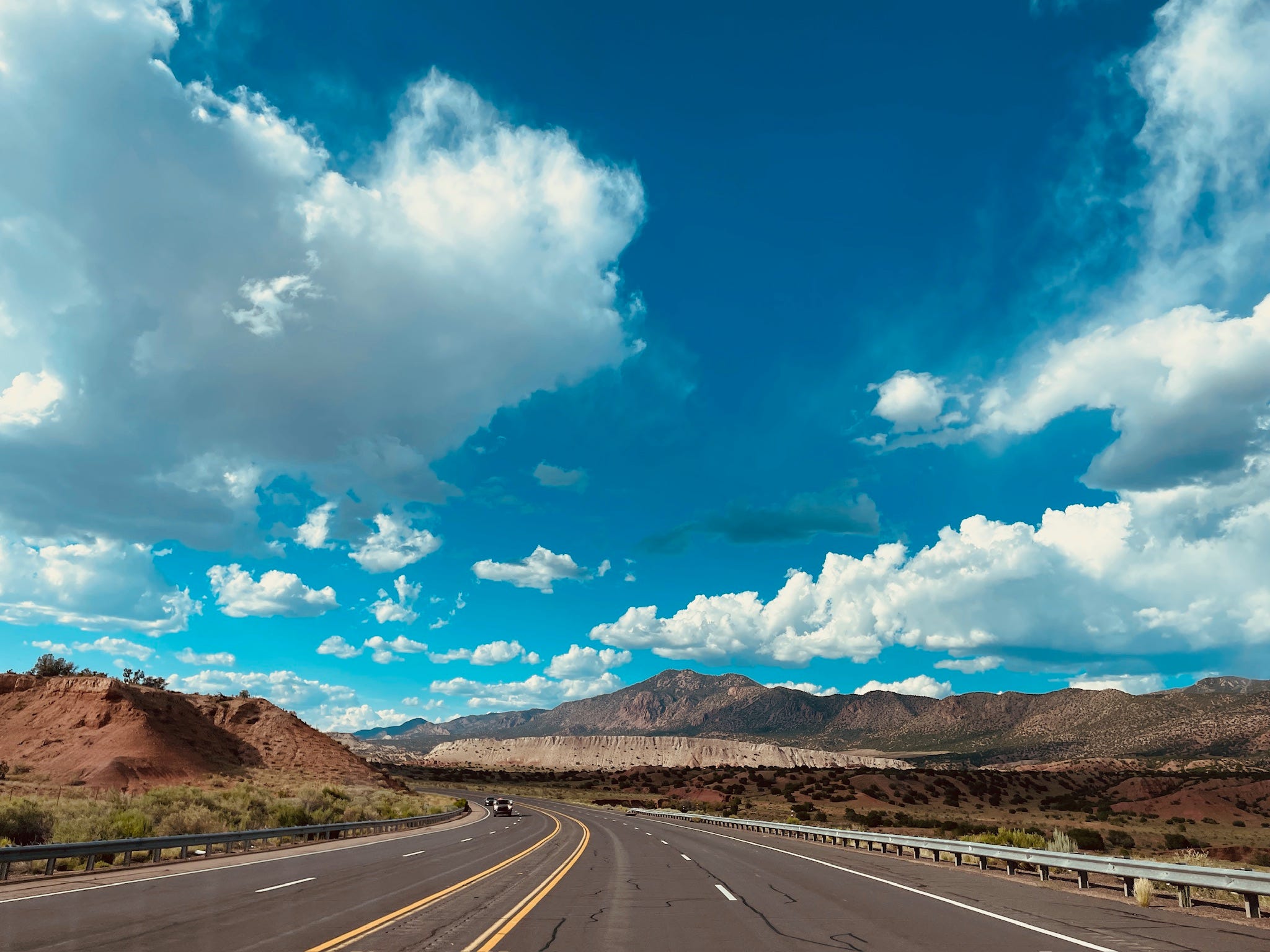
The profoundly simple vibe changing practice of looking up.
A subtle evolutionary change has messed us up more than we realize.

Twenty years ago, people didn’t have smartphones.
Fifty years ago, people didn’t have computers.
A hundred years ago, people didn’t have desk jobs.
Before that, people didn’t have electricity in their homes, and life was mostly spent outside — working in fields, mines, or factories. Big places.
Way back before that — and for thousands of years— life was entirely outside, and danger was everywhere. Humanity evolved in a state of difficult survival. It was basically: get food, and try not to get eaten in the process.
That’s how mankind has spent the vast majority of its existence.
Things are different now, but our shared evolution is worth considering. We still have these instincts baked into us. Our rat brains are hard-wired for it.
Imagine life 100,000 years ago. You’re outside, wearing animal skins — or more likely nothing at all. You’re carrying something for personal protection, like a club. You’re picking berries or looking for a small animal to kill for a meal.
You’re constantly scanning the horizon for danger, weather, food, humans — everything. Your life is outside, and outside is huge. Your head is on a swivel. As you walk through the land, your eyes are darting all around you. Your ears are at nonstop attention. Your nose is translating potential threats to your brain in rapid succession.
If you’ve ever hiked in bear country, you know a bit of what this feels like. There’s a steady awareness that sharpens your senses and lights you up in a different kind of way.
But people don’t spend much time in bear country these days.
My point is, we’ve stopped looking out. Over time our “danger zone” has shrunken from all-of-creation down to little more than arm’s reach.
Instead of being out there, the world is in our hands now—our jobs, our social circles, our income, our enjoyment. All of it starts and stops on these phones.
And I’m wondering if our current anxiety problem might be related to the fact that we aren’t looking out very much anymore. We don’t feel safe because we are only looking at what’s in our hands.
Let’s think back to the caveman again. If he was only focused on things within arm’s reach, he’d be dead within a week. That sort of lifestyle would be unbelievably scary. You’d be telling that person to look out — every day.
So I’ve been practicing it in my daily life. Looking out toward the horizon. Looking far into the distance. Scanning. Not so much for threats, but more just to expand my overall awareness in some greater metaphysical way.
And what I’ve discovered in the last couple of weeks, is that I feel safer and less anxious overall. It’s like I’ve tapped into that pre-historic security that comes simply from looking around to make sure that I’m actually okay. There’s a sureness in it.
I’ve taken a very small circle of safety (arm’s reach) and broadened it out to everything I can see. I’ve done the very thing my caveman companion would have urged me to do 100,000 years ago.
“You gotta keep your eyes up, man.”
And when you keep your eyes up, a profound feeling of safety and security will wash over you as you gain this new awareness — that nothing out there is going to eat you.
And suddenly, something interesting happens out of that deeper sense of peace: you start to relax, and dream, and imagine again. There’s a looseness that comes from it.
You start to feel safe enough to exist more peacefully. You begin to hope that you might actually survive all of this.
That you are capable, secure, and adequate to meet the challenges ahead.
Imagine that.
It’s an amazing feeling.
Try it for a week.
Broaden your gaze. Look up and notice what’s out there — as far as you can see. Register the animals, the trees, the people, the greater spaces around you.
Just catalog it for thirty seconds a few times each day.
Get outside where you can see into the distance, and let the currency of the horizon reassure you — you are are going to be ok.
There’s a lot of peace in that. Peace I think we all need.
But we gotta look for it.